
6. Change Your Viewing Distance
Move farther away or make the image smaller.
7. Give Your Brain Time
Sometimes the pattern doesn’t appear immediately.
Keep scanning rather than forcing yourself to find it in one particular spot.
What Makes This Puzzle Different From an Ordinary “Spot the Difference” Game?
A spot-the-difference puzzle usually asks you to locate a specific change between two images.
A hidden-image puzzle works differently.
There may be only one image.
The challenge is to discover a second visual interpretation hidden inside the first.
You’re not necessarily looking for something that’s missing.
You’re looking for something that’s already there but being interpreted differently.
That’s why the solution can feel almost magical.
Frequently Asked Questions
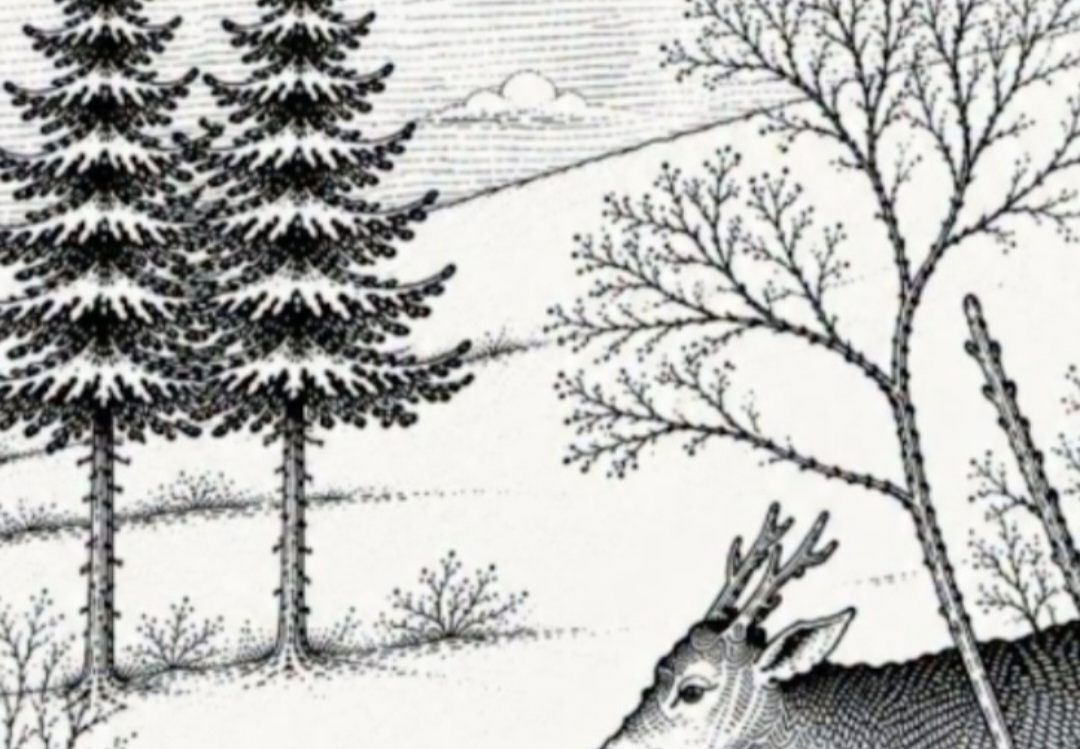
Where is the hidden face in the winter picture?
The supplied description establishes that a human face is hidden within the arrangement of trees, branches, shadows, and open spaces, but it does not provide enough information to identify its precise location without the actual image.
Why is the face difficult to see?
The surrounding elements are initially interpreted as ordinary parts of a forest scene. Once your brain categorizes them as trees, branches, snow, and shadows, it can be harder to recognize those same shapes as parts of a face.
Does the deer have anything to do with the hidden face?
The deer acts primarily as a strong visual anchor. Because it’s an immediately recognizable object, it can draw attention away from the surrounding shapes where the hidden face is suggested.
What is negative space?
Negative space is the area surrounding or between objects in an image. In visual puzzles, those apparently empty areas can help create larger shapes or hidden figures.
Why does looking at a smaller image sometimes help?
Reducing an image can make tiny details less dominant and allow larger patterns to become easier to recognize.
What should I look for first?
Start by moving your attention away from the obvious deer. Examine the entire forest, including the spaces between trees, branches, shadows, and patches of snow.
Final Thoughts
This winter forest puzzle is a perfect example of how seeing isn’t always the same as noticing.
At first, you see exactly what you’d expect: snow, trees, and a deer.
But the puzzle asks you to look again.
The hidden face isn’t necessarily concealed behind an obvious object. Instead, it’s suggested through pieces of the landscape that your brain has already categorized as ordinary scenery.
And that’s what makes these puzzles so much fun.
The next time you can’t find a hidden image, don’t simply stare harder.
Look differently.
Move away from the obvious subject. Examine the negative space. Look at the shadows. Follow the branches. Change the viewing distance.
Sometimes the answer isn’t hidden at all.
Your brain just hasn’t put the pieces together yet.
Keep reading — tap the button below to continue.