
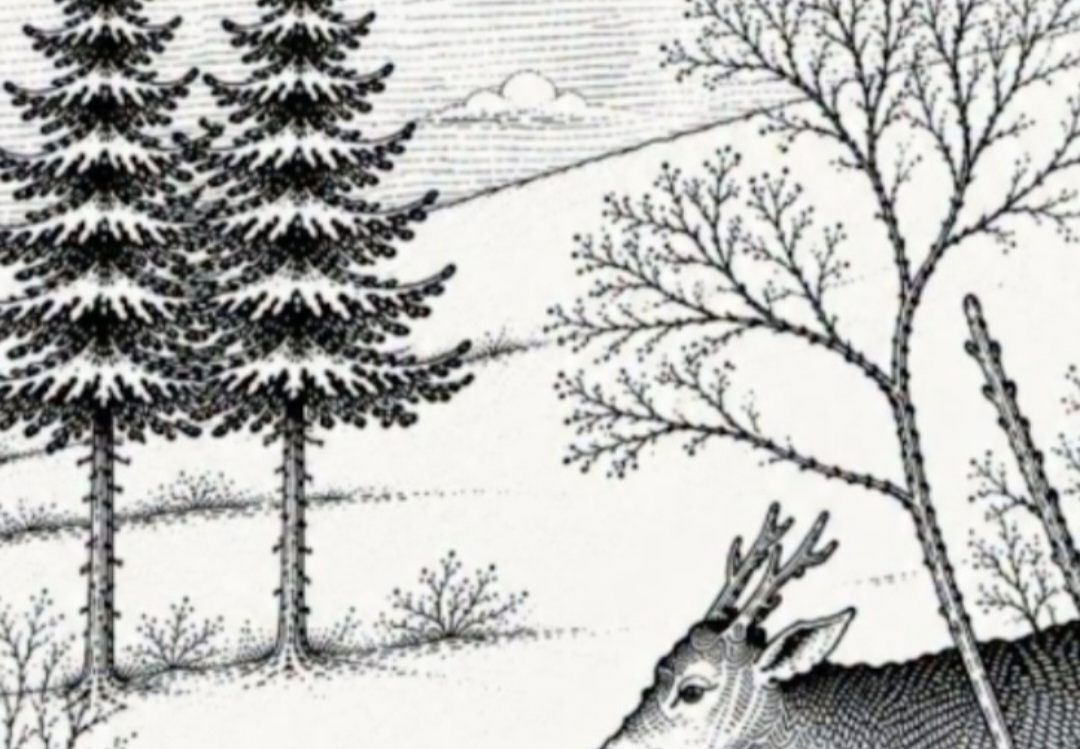
portrait. There isn’t necessarily a clear outline around it, either. Instead, several ordinary parts of the forest work together to create a second image.And once you finally see it?You may wonder how you missed it in the first place!Can You Find the Hidden Face?Before reading any further, take another look at the winter scene.Don’t focus exclusively on the deer.Instead, allow your eyes to wander across the entire image.Look between the tree trunks.Look at the branches.Pay attention to the dark and light areas.And don’t ignore the snow-covered spaces simply because they appear empty.The hidden image may depend on several of these elements working together rather than one obvious shape.That’s the beauty of a hidden-image puzzle.The picture doesn’t necessarily hide something by making it invisible.It hides it by making you interpret it as something else.Why Do You Notice the Deer First?There’s a very good reason the deer grabs your attention.It’s a recognizable object with a clear outline.Your brain doesn’t have to work very hard to figure out what you’re looking at.You see the animal’s body, legs, head, and overall shape, and almost instantly your mind categorizes itYou see the animal’s body, legs, head, and overall shape, and almost instantly your mind categorizes it:
That’s a deer.
Once that happens, the animal becomes the subject of the picture.
Everything around it becomes scenery.
The trees become background.
The snow becomes background.
The shadows become background.
And that’s where the puzzle gets clever.
The hidden face is believed to be constructed from some of the very details your brain has already decided aren’t important.
The Trick Is to Stop Looking at the Picture Normally
When you look at an ordinary photograph, you naturally search for recognizable objects.
You might notice a person.
Then a vehicle.
Then a building.
Then perhaps an animal.
Your brain constantly organizes the visual information into meaningful objects.
But a hidden-image puzzle asks you to do something different.
Instead of asking:
“What objects are in this picture?”
Try asking:
“What shapes are these objects creating together?”
That’s a completely different way of looking.
A tree doesn’t necessarily have to represent a tree.
A shadow doesn’t necessarily have to represent a shadow.
A patch of snow doesn’t necessarily have to represent snow.
They can become pieces of a much larger shape.
Look at the Negative Space
One of the best ways to approach a puzzle like this is to pay attention to negative space.
Negative space is essentially the area surrounding or separating the main objects in an image.
In a forest scene, that might include:
The spaces between tree trunks
Gaps between branches
Patches of snow
Dark areas beneath trees
Open areas between objects
The boundaries where light meets shadow
These spaces may seem insignificant when you’re looking for a deer.
But they can become extremely important when you’re looking for a hidden face.
A bright patch of snow might contribute to the appearance of a cheek.
A dark space might suggest an eye.
A tree trunk could help create the edge of a face.
A branch could form part of an eyebrow, nose, or other facial feature.
Individually, those shapes may look completely ordinary.
Together, they can suggest something surprisingly recognizable.
The Face May Not Have a Clear Outline
This is one of the reasons hidden-image puzzles can be so frustrating.
We naturally expect an object to have an outline.
If someone draws a face, we’d expect to see a forehead, cheeks, chin, eyes, nose, and mouth.
But a hidden face doesn’t have to work that way.
The image can be fragmented.
One part of the forest may suggest one facial feature while another part supplies something completely different.
Your brain then connects those pieces.
Suddenly, what looked like a collection of unrelated branches starts to resemble a face.
That’s the moment when the puzzle seems to change.
The image hasn’t changed at all.
Your interpretation has changed.
Try Scanning the Entire Image
If you haven’t spotted the face yet, don’t stare at the same area over and over.
Try a systematic approach instead.
Start at one side of the image.
Slowly move your eyes across the scene.
Then work back in the opposite direction.
As you scan, pay attention to unusual combinations of shapes.
Look for:
Curved branches
Unusually dark patches
Symmetrical-looking areas
Shapes resembling eyes
Lines that could suggest a nose
Light areas that might form cheeks or a forehead
Large shapes that don’t seem to belong to the obvious objects
The important thing is to stop treating every tree, shadow, and patch of snow as a separate object.
Try seeing the forest as one giant collection of shapes.
Why Your Brain Can Suddenly “See” the Face
There’s something fascinating about the moment a hidden image becomes recognizable.
Before you see it, the relevant shapes may seem completely random.
Then suddenly:
There it is.
Once your brain recognizes the pattern, it’s often difficult to return to the original interpretation.
The branches are still branches.
The snow is still snow.
The shadows haven’t moved.
Yet now they seem to form something else.
This happens because human vision is constantly trying to organize complicated visual information into meaningful patterns.
That’s extremely useful in everyday life.
Imagine trying to consciously analyze every individual shape, color, shadow, and movement you encounter while walking down a street.
It would be overwhelming.
Instead, your visual system quickly organizes the scene.
You recognize a car.
You recognize a person.
You recognize a tree.
You recognize a doorway.
That efficiency is incredibly useful—but a puzzle designer can turn it into a challenge.
The Deer Is a Visual Distraction
The deer isn’t necessarily part of the trick in the traditional sense.
It’s simply such an obvious object that it can dominate your attention.
Once you’ve identified it, your brain has already decided what the picture is about.
It’s a winter forest with a deer.
Case closed.
Except it isn’t.
The hidden face encourages you to reconsider the parts of the image you’ve mentally labeled as background.
That’s why moving your attention away from the deer can help.
Instead of making the animal the center of your search, treat it as just one small component of the overall composition.
Try Changing Your Viewing Distance
Still can’t find it?
Try moving farther away from the screen.
This sounds almost too simple, but changing viewing distance can alter how you perceive an image.
When you’re very close, tiny details can become dominant.
You may notice individual branches, textures, shadows, and patches of snow.
Those details can make it harder to recognize the larger pattern.
Move farther away and some of those small details begin to blend together.
The larger shapes can become easier to perceive.
You haven’t changed the picture.
You’ve simply changed the scale at which you’re viewing it.
Try Looking at a Smaller Version
There’s another trick you can try.
Make the image smaller.
A hidden figure can sometimes become easier to recognize when an image is reduced in size.
Why?
Because tiny details lose some of their individual importance.
Branches blend together.
Small patches of contrast become less distracting.
The overall arrangement becomes more prominent.
That’s one reason some hidden images seem surprisingly obvious when viewed as a thumbnail, even though they’re difficult to identify when examined up close.
Don’t Search for a Perfectly Drawn Face
This is perhaps the biggest mistake you can make.
If you’re expecting to find a perfectly outlined human face, you may overlook it entirely.
Instead, look for suggestions of facial features.
Ask yourself:
Could these two dark areas be eyes?
Could this curved shape suggest a nose?
Could this lighter area form part of a cheek or forehead?
You’re not necessarily looking for a literal drawing.
You’re looking for a visual arrangement that your brain can interpret as a face.
That’s an important distinction.
Why Faces Are So Easy to Recognize
Humans are remarkably good at detecting faces.
We encounter them constantly throughout our lives, so our visual systems are highly sensitive to facial patterns.
Sometimes, that sensitivity even causes us to perceive faces where none were deliberately created.
You might see a face in:
Clouds
Rock formations
Tree bark
Buildings
Shadows
Household objects
This tendency is often called pareidolia—the experience of perceiving a familiar pattern, especially a face, in an otherwise ambiguous visual arrangement.
A hidden-image puzzle can take advantage of exactly that tendency.
Instead of placing a face directly into the picture, the designer can arrange ordinary shapes so that they collectively suggest one.
Why Hidden-Image Puzzles Are So Addictive
There’s a special satisfaction that comes from solving a puzzle like this.
At first, you see only a winter landscape.
Then you notice something strange.
You look again.
You scan the trees.
You check the shadows.
You change your viewing distance.
And eventually, the hidden pattern clicks.
That little moment of recognition is what makes these puzzles so enjoyable.
You’re not simply being asked to count objects or solve an equation.
You’re being asked to change the way you see the image.
A Simple Strategy for Solving Hidden-Image Puzzles
If you regularly enjoy these kinds of visual challenges, here’s a useful method to remember.
1. Find the Obvious Object
Identify whatever immediately grabs your attention.
In this picture, that’s the deer.
2. Stop Focusing on It
Once you’ve identified the obvious subject, deliberately move your attention elsewhere.
3. Examine the Background
Look at trees, shadows, branches, and spaces between objects.
4. Study Negative Space
Don’t just look at the objects themselves.
Look at the shapes created between them.
5. Search for Facial Features
Look for possible eyes, nose, cheeks, forehead, and mouth.
They don’t have to be complete or clearly outlined.