
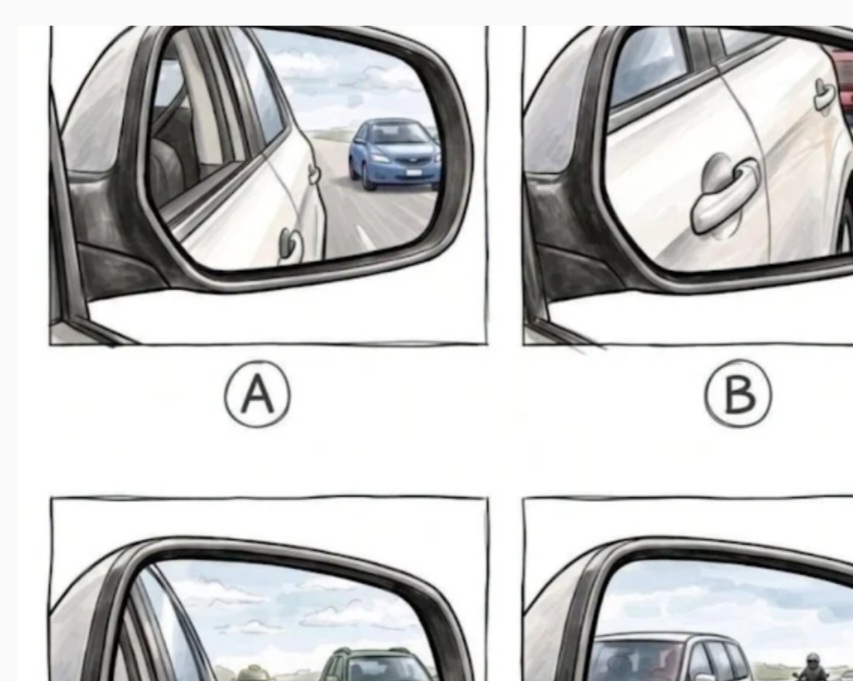
How to Set Your Mirrors the Right Way
The following steps describe the outward-adjusted method.
Step 1: Start With the Rearview Mirror
Sit in your normal driving position and adjust the inside rearview mirror so you can see as much of the rear window as possible.
Make sure the mirror is positioned comfortably without requiring you to lean or change your normal seating posture.
Step 2: Adjust the Left Side Mirror
Lean your head toward the driver’s window until it is close to the glass.
From that position, adjust the left mirror outward until you can just barely see the side of your vehicle.
Step 3: Adjust the Right Side Mirror
Next, lean your head toward the center of the vehicle, above the center console.
Adjust the right mirror outward until you can just barely see the side of your car from that position.
Step 4: Return to Your Normal Driving Position
Sit upright in your usual driving position.
You should now see little or none of your own vehicle in either side mirror. Instead, the mirrors should show more of the lanes beside you, similar to setup D.
The purpose is to expand your view of surrounding traffic rather than use valuable mirror space to look at your own doors.
How to Test Your Mirror Adjustment
Once you’ve adjusted your mirrors, you can check how well the views work together.
On a safe, familiar multi-lane road, observe a vehicle passing you while maintaining your lane and normal driving speed.
Ideally, you should see the vehicle in your inside rearview mirror first. As it moves alongside you, it should become visible in the appropriate side mirror and then in your peripheral vision.
If the vehicle disappears completely between these viewing areas, your mirrors may need further adjustment.
Never rely on this test as proof that every blind spot has been eliminated. Traffic conditions, vehicle size, mirror design, and seating position can all affect what you can see.
Important Things Every Driver Should Remember
It may feel strange at first. If you’re accustomed to seeing your own car in the side mirrors, an outward adjustment can take some getting used to. Give yourself time to become familiar with the new viewing angles.
Mirrors aren’t perfect. Even carefully adjusted mirrors cannot show every area around your vehicle. Motorcycles, bicycles, and smaller vehicles can be particularly easy to overlook.
Always perform a shoulder check. Before changing lanes, check your mirrors and briefly look over your shoulder toward the lane you’re entering. Mirrors are an important aid, but they should never replace direct observation.
Your vehicle type matters. Trucks, vans, SUVs, and vehicles with different mirror designs may require different adjustments. Follow your owner’s manual and make sure you have a clear view around your particular vehicle.
Adjust mirrors before driving. Never lean over or try to reposition your mirrors while the vehicle is moving. Set them before starting your journey and check them again if someone else has driven your car.
The Takeaway: A Better Mirror View Can Make a Difference
The best mirror setup isn’t necessarily the one that lets you see the side of your own car. It’s the one that gives you the clearest possible view of the traffic around you.
An outward-adjusted mirror position can help reduce blind-spot coverage gaps and improve your awareness of vehicles approaching from behind.
Take a couple of minutes before your next drive to check your mirror positions. Combine properly adjusted mirrors with regular shoulder checks, careful observation, and safe lane-changing habits.
A small adjustment can make a meaningful difference when you’re sharing the road with other drivers.