
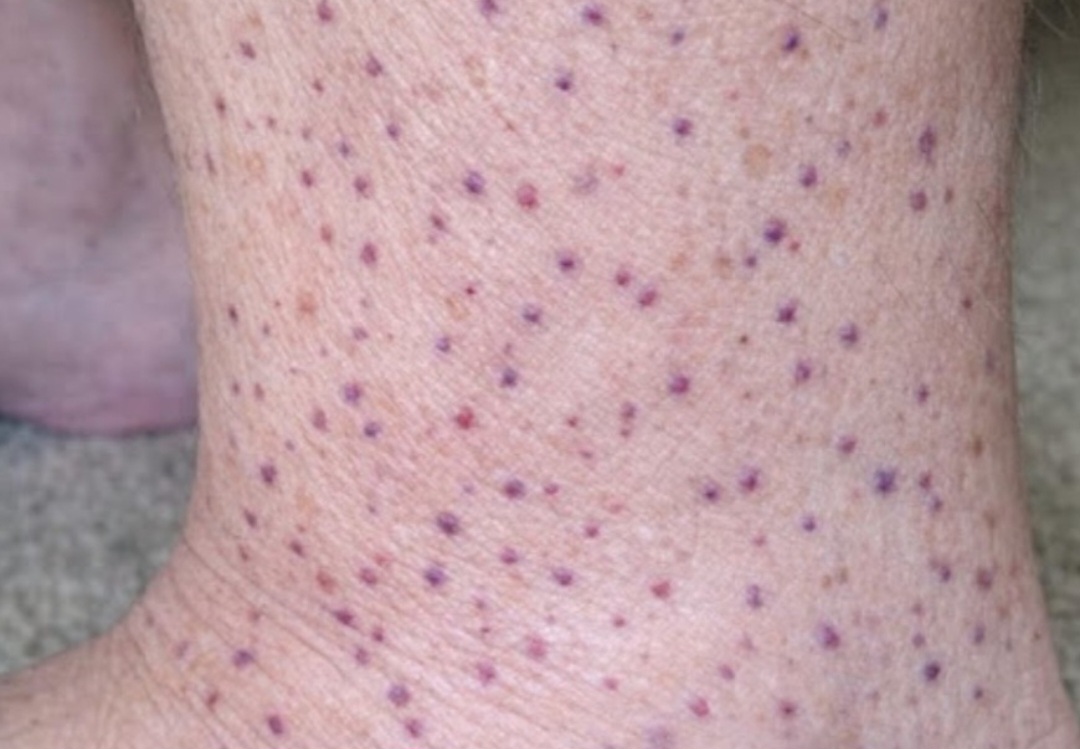
- Release the pressure and look again.
Spots that remain visible may be non-blanching, which can be consistent with petechiae or larger areas of bleeding under the skin, called purpura.
Do not use the test to rule out a serious illness. Some dangerous rashes may blanch early in their course, and the test can be difficult to interpret on different skin tones. If someone is seriously unwell, do not delay medical care to perform it or repeat it.
3. Why Do Petechiae Often Appear on the Lower Legs and Ankles?
The lower legs are a common place to notice certain forms of small-vessel bleeding, including some conditions associated with inflammation of the blood vessels.
Pressure, friction, prolonged activity, and physical strain may contribute to localized spots in some circumstances. For example, intense coughing, vomiting, or straining can sometimes cause petechiae, particularly around the face and upper body.
However, the location of the spots does not establish their cause.
New spots appearing across both legs, increasing in number, spreading toward the thighs, or developing on the arms or torso deserve particular attention. These patterns can occur for different reasons, including problems involving platelets, blood clotting, blood vessels, infections, or medications.
A rash that is spreading should not automatically be attributed to gravity, tight socks, or a long day of standing.
4. What Can Cause Petechiae?
Petechiae develop when tiny blood vessels leak blood into the skin. Several different processes can lead to this, so the surrounding circumstances and any other symptoms matter.
Minor physical strain or pressure
Activities that place considerable strain on the body can sometimes cause small blood vessels to rupture.
Possible triggers include:
- Repeated or forceful coughing
- Intense vomiting
- Heavy lifting or strenuous exertion
- Significant local pressure or friction
When physical strain is responsible, the spots may be limited to a particular area, and the person may otherwise feel well. Nevertheless, a new or unexplained rash should not be assumed to have a harmless cause simply because physical activity occurred beforehand.
Medication effects
Some medications can increase bleeding risk or affect platelet function. Examples include aspirin, certain anti-inflammatory medicines such as ibuprofen, anticoagulants, and some other prescription drugs.
Certain antibiotics and other medications may also be associated with low platelet counts or skin reactions in some people.
The connection depends on the particular medicine, dose, medical history, and timing. Do not stop a prescribed blood thinner or another essential medication without professional advice. If a new rash develops after starting or changing a medication, contact a healthcare professional promptly.
Low platelet counts or clotting problems
Platelets help the blood form clots and stop bleeding. When platelet levels are too low or their function is impaired, tiny blood vessels may leak more easily.
Possible clues include unexplained bruising, frequent nosebleeds, bleeding gums, or unusually heavy bleeding. Some people, however, may initially notice only skin changes.
Blood-clotting disorders and certain other blood conditions can also produce petechiae or purpura. A medical assessment and, when appropriate, blood tests are needed to investigate these possibilities.
Infections and other medical conditions
Some viral and bacterial infections can cause petechiae. In certain circumstances, a non-blanching rash may accompany a serious infection, including meningococcal disease, which can progress rapidly.
Other possible causes include inflammation of small blood vessels, immune-related conditions, and some disorders affecting the blood or bone marrow.
Because the causes vary widely, the spots cannot be reliably diagnosed from a photograph or home examination alone.
5. When Are Tiny Purple Spots a Medical Emergency?
The most important question is not simply what the spots look like, but whether they are accompanied by symptoms suggesting a serious underlying problem.
Seek emergency medical care immediately if a new non-blanching rash occurs with any of the following:
- Fever with severe headache, a stiff neck, or sensitivity to light
- Confusion, unusual drowsiness, fainting, or difficulty waking
- Trouble breathing, rapid deterioration, or severe weakness
- Cold, clammy, or unusually pale skin, especially with dizziness or collapse
- Severe abdominal pain or other intense, unexplained pain
- Rapidly spreading purple spots or large areas of unexplained bruising, particularly when the person feels unwell
A serious infection can sometimes develop before all the classic warning signs appear. Do not wait for every symptom to emerge.
If the person appears seriously ill, call your local emergency number. Do not drive them yourself if they are confused, collapsing, struggling to breathe, or otherwise unstable.
What if the person feels completely normal?
New, unexplained petechiae that are spreading or appearing in large numbers still warrant urgent medical assessment, even without fever or pain.
If you cannot obtain timely medical advice locally, seek an emergency department rather than waiting several days to see whether the spots disappear.
A small, localized cluster after an obvious episode of physical strain may have a less serious explanation, but persistent, recurrent, or unexplained spots should still be discussed with a healthcare professional.
6. What to Do in the First 10–30 Minutes
If you discover unexplained purple spots on someone’s legs, it can help to focus on a few practical steps rather than trying multiple creams or home remedies.
Step 1: Assess how the person feels
Ask whether they have a fever, headache, dizziness, unusual fatigue, shortness of breath, abdominal pain, or any other new symptoms.
Check whether they are alert and behaving normally. If they are confused, difficult to wake, or visibly deteriorating, seek emergency help immediately.
Step 2: Look at the distribution of the spots
Notice whether the marks are confined to one small area or spread across both legs. Check whether new spots are appearing elsewhere, such as the arms, torso, or inside the mouth.
You can take a photograph in good lighting to document the appearance and any subsequent changes. This may help a clinician assess the progression, but it should never delay seeking care.
Step 3: Review recent changes
Think about whether the person has recently:
- Started a medication or changed a dose
- Had a recent illness or fever
- Experienced repeated coughing or vomiting
- Developed unusual bruising or bleeding
- Had similar spots before
Write down any relevant details and bring a list of medications, including over-the-counter products and supplements, if medical evaluation is needed.
Step 4: Arrange appropriate medical care
Do not spend the next half hour repeatedly pressing the spots, searching for creams, or waiting for the rash to change color.
If there are emergency warning signs, get emergency help immediately. If the person feels well but has new, unexplained, spreading non-blanching spots, arrange urgent medical evaluation.
Avoid starting aspirin or ibuprofen specifically to treat the spots unless a healthcare professional advises you to do so. These medicines can affect bleeding, and the appropriate choice depends on the person’s circumstances.
7. How Are Petechiae Diagnosed and Treated?
Treatment depends on what caused the bleeding beneath the skin.
A healthcare professional will typically ask when the spots appeared, whether they are spreading, what medications the person takes, and whether other symptoms or recent illnesses are present.
The examination may include checking the skin and looking for bruising or bleeding elsewhere. Depending on the circumstances, testing may include:
- A complete blood count to assess platelet levels and other blood cells
- Blood-clotting tests
- Additional blood tests or investigations guided by the symptoms and examination
Not everyone needs every test. The clinician decides which investigations are appropriate.
If a specific medication or medical condition is responsible, treatment will focus on that cause. For example, an infection may require targeted treatment, while a platelet or clotting disorder may need specialist assessment.
There is no single cream that treats petechiae themselves. Because the spots represent bleeding beneath the skin, treating the underlying cause is more important than treating the surface appearance.
Frequently Asked Questions
Are petechiae always dangerous?
No. Petechiae can occur after physical strain or for other relatively minor reasons. However, they can also signal serious infection, low platelet counts, or other medical conditions. New, unexplained, or spreading spots should be assessed rather than automatically dismissed.
Can petechiae disappear on their own?
They may fade as the body gradually reabsorbs the blood beneath the skin, particularly when the underlying cause is temporary. But fading does not prove that the original cause was harmless. Medical advice is important when the spots are unexplained, widespread, recurrent, or accompanied by other symptoms.
Do petechiae itch or hurt?
They are often neither itchy nor painful. However, the underlying condition may cause other symptoms, and some related skin conditions can be uncomfortable. Itching or the absence of pain cannot reliably determine whether the cause is serious.
Can a glass test tell me whether I need emergency care?
No. A non-blanching result can be an important warning sign, but the glass test is not a diagnostic tool and cannot determine the cause. A blanching rash can also occur with serious illness. Decisions about emergency care should be based on the person’s overall condition, accompanying symptoms, and the appearance and progression of the rash.
Should I wait until morning if the spots appear late at night?
Do not wait if the person has emergency warning signs or the rash is rapidly spreading alongside illness. Seek emergency help immediately. If the person feels well but has a new, unexplained non-blanching rash, obtain urgent medical advice rather than assuming it can safely wait until morning.
The Most Important Thing to Remember
Tiny purple spots on the lower legs can have several explanations, and not every case is an emergency. But new, spreading, non-blanching spots deserve attention because they can indicate bleeding beneath the skin.
Look at the person’s overall condition, recognize warning signs, and seek appropriate medical care instead of relying on a home test or skin treatment to decide that everything is fine.
When a rash appears suddenly and its cause is unclear, caution is more useful than reassurance based on appearance alone.