
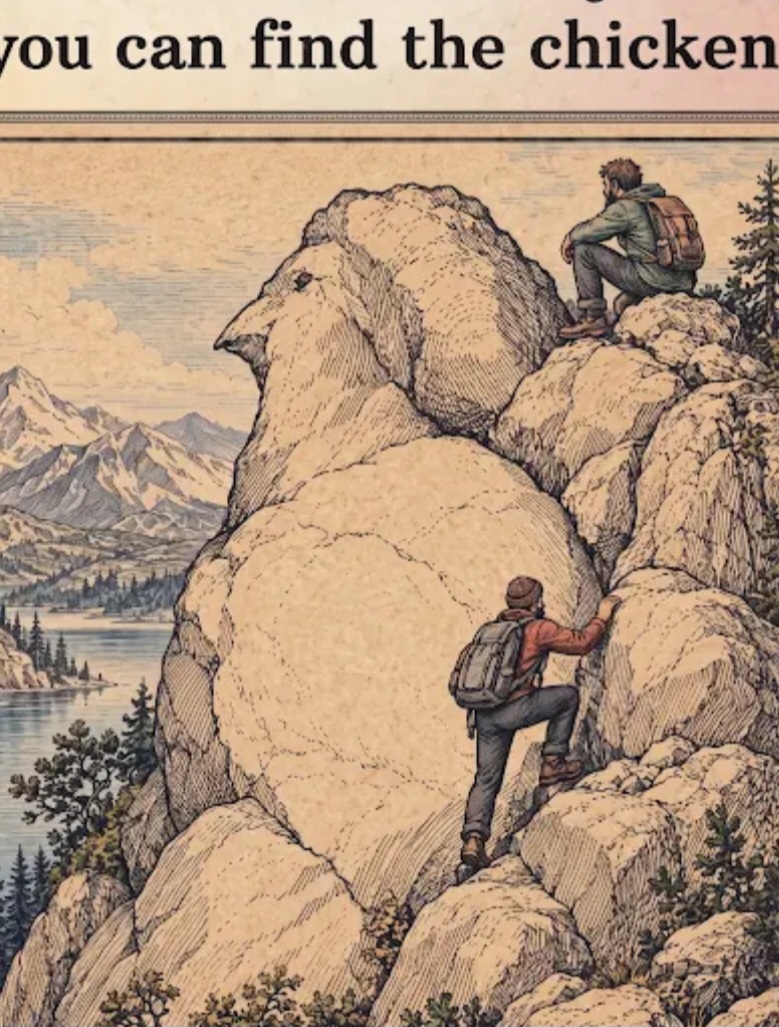
At first glance, this picture looks surprisingly ordinary: two men, a rocky cave, and a collection of shadows and uneven stone formations.But there’s a catch.A chicken is hiding somewhere in the image—and you have just 10 seconds to find it.Ready?Take a close look before scrolling down to the answer.Don’t zoom in.Don’t ask someone else.And definitely don’t give up after the first few seconds!Start your timer and see if you can spot the hidden chicken before the 10 seconds are up.The Hidden Chicken ChallengeMost people begin by scanning the center of the image.That seems logical.We naturally expect a hidden object to stand out once we know what we’re searching for. But after a few seconds, something strange happens.The rocks, shadows, and irregular shapes begin to compete for your attention.Suddenly, what looked like a simple picture becomes a surprisingly difficult visual puzzle.If you haven’t spotted the chicken yet, don’t worry.You’re not necessarily missing it because you have poor eyesight.There’s something else going on.Start the 10-Second ChallengeLook at the entire picture before focusing on any one particular area.Try scanning:The rocksThe darker shadowsThe spaces around the two menThe edges of the caveUnusual shapes and outlinesAreas where light and shadow meetAnd remember:The chicken may not look like an obvious chicken at first.That’s what makes the puzzle so tricky!Why Is the Chicken So Difficult to See?The challenge has a lot to do with how our brains process visual information.We don’t examine every single detail of an image equally. Instead, our attention automatically prioritizes certain things.Human faces, strong contrasts, familiar objects, movement, and areas that appear important tend to attract our attention first.Meanwhile, smaller shapes that blend into their surroundings can be surprisingly easy to overlook—even when they’re technically right there in front of us.That’s why one person might spot the chicken almost immediately while another can stare at the same picture for several minutes without seeing it.It’s not necessarily about being smarter or having better eyesight.It’s about where your attention goes first.Your Brain Is Trying to Make Sense of the SceneWhen you first look at this image, your brain immediately begins organizing what it sees.You recognize people.You recognize rocks.You recognize the cave-like surroundings.You begin building a mental picture of the scene.And once your brain has decided, essentially, “This is a picture of two men in a rocky area,” it may not carefully inspect every irregular shape for something unexpected.That’s one reason hidden-object puzzles can be so effective.The object isn’t necessarily invisible.Your attention simply isn’t looking for it in the right way.If you’ve already spent 10 seconds searching, try again.
But this time, don’t look for a complete chicken.
Instead, look for chicken-like shapes.
Pay attention to:
Shapes
Does any rock formation have the outline of an animal?
Shadows
Could a dark patch contain more detail than you initially noticed?
Edges
Objects partially hidden by other objects can be much harder to recognize.
Negative space
Sometimes the shape you’re looking for is defined by the area surrounding it rather than by a strong outline.
This is where the puzzle becomes really interesting.
Did You Find It?
Before revealing the answer, take one last look.
Seriously.
Give yourself another 10 seconds.
Start at one side of the picture and slowly scan toward the other.
Don’t jump around randomly.
Look at each section before moving to the next.
Did you spot the chicken?
If you did, congratulations!
If you didn’t, you’re definitely not alone.
Some hidden-object puzzles are designed specifically so that the answer becomes obvious only after someone points it out.
And once you finally see it?
You may wonder how you missed it in the first place.
The Hidden Chicken Revealed
There it is! 🐔
The chicken is cleverly camouflaged within the rocky surroundings, using the shapes, shadows, and natural irregularities of the scene to disguise its outline.
Once you know where to look, the shape becomes much easier to recognize.
And that’s the funny thing about visual puzzles.
Before the reveal, your brain sees:
rocks + shadows + people.
After the reveal, your brain sees:
“Wait… how did I not see that chicken?”
Suddenly, the hidden shape seems much more obvious.
Why Does It Become Easier After You See It?
This is one of the most satisfying parts of a hidden-object puzzle.
Once you’ve identified the target, your brain has a new visual template for what you’re searching for.
Instead of looking at a random collection of rocks, you’re now looking for the specific shape of a chicken.
That changes the way you scan the image.
The same picture hasn’t changed.
Your interpretation of it has.
This is one reason visual puzzles can feel almost magical.
Don’t Confuse This With an Eyesight Test
There’s an important distinction here.
Not finding the chicken in 10 seconds doesn’t mean you have poor vision.
And finding it instantly doesn’t prove that you have extraordinary eyesight or a higher IQ.
This is simply a visual attention and observation challenge.
Your result can be influenced by many ordinary factors, including:
- How familiar you are with hidden-object puzzles
- Where you look first
- How visually crowded the image is
- The contrast and lighting in the picture
- How long you spend searching
- Whether you already know what the hidden object looks like
So don’t take your result too seriously.
The point is to have fun.
What Makes Hidden-Object Puzzles So Addictive?
There’s a little moment of satisfaction that happens when you finally find the hidden object.
At first, you’re confused.
Then you notice something unusual.
Your brain connects the shapes.
And suddenly—
There it is!
That little “aha!” moment is what keeps people coming back for another puzzle.
It’s the same reason people enjoy optical illusions, spot-the-difference games, word searches, and other visual challenges.
We like solving things that initially seem impossible.
Try These Search Strategies
If you regularly struggle with hidden-object puzzles, don’t simply stare harder.
Try changing how you look.
Scan systematically
Start at the top-left corner and move across the image slowly.
Then work downward row by row.
This reduces the chance of repeatedly checking the same area.
Look at the edges
People often concentrate on the center of an image.
Hidden objects can be much harder to notice near the edges.
Search for outlines
Instead of asking, “Where is the chicken?”
Ask:
“Where do I see a shape that doesn’t quite belong?”
Change your focus
Look at the image from a little farther away.
Then move closer.
Sometimes a large shape becomes easier to recognize when you’re not concentrating on individual details.
Look at negative space
Don’t just examine the objects.
Look at the spaces between them.
Sometimes your brain recognizes a hidden figure from the shape of the empty space around it.
Can You Find It Faster the Second Time?
Now that you’ve seen the solution, try looking at the image again.
You may notice that the chicken seems dramatically easier to see.
That’s part of the fun.
The first time, you’re searching without a visual reference.
The second time, you already know what the hidden shape looks like.
Your search becomes much more targeted.
That’s why these puzzles can feel completely different before and after the reveal.
Challenge Your Friends
Think you found the chicken quickly?
Don’t tell everyone where it is.
Send the image to a friend and simply ask: