
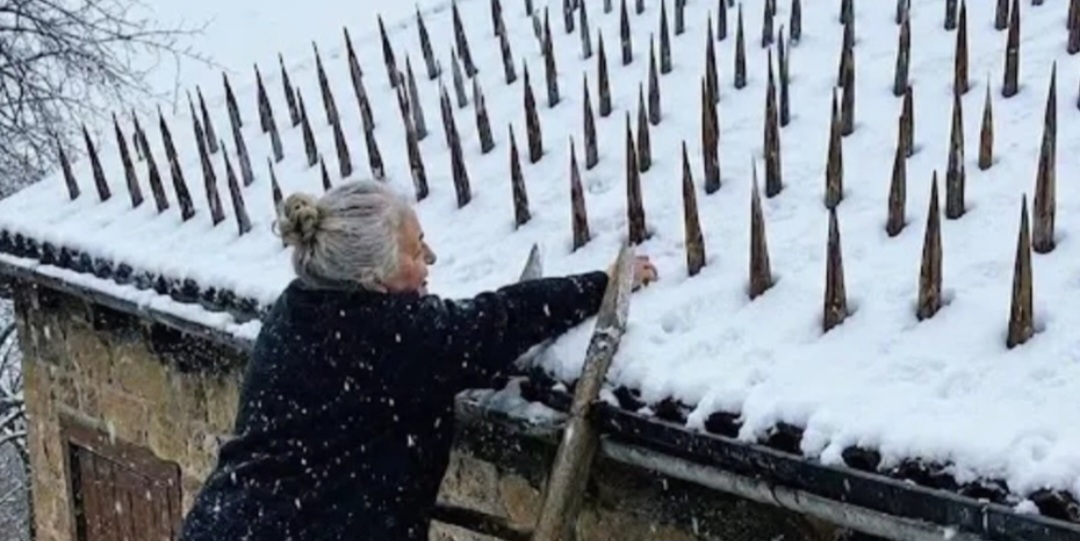
Then Winter ArrivedThe first snow came quietly.A thin white layer covered the fields and rooftops.For a few days, nothing happened.Then the wind arrived.It began as a low whistle through the trees.By nightfall, it had become a roar.The wind tore through the valley with terrifying force.Trees bent almost to the ground. Fences snapped. Branches crashed onto roads and yards.People woke to the sound of their houses groaning.Then came the first reports of damaged roofs.By morning, sheets of roofing material were scattered across the village.One house had lost half its shingles.Another had a section of roof ripped away completely.Barn doors were hanging from broken hinges.Trees had fallen across roads.The storm continued for hours.Then, almost as suddenly as it had arrived, it disappeared.The valley fell silent.Villagers slowly emerged from their homes to see what remained.And then they noticed Mrs. Gable’s house.It was still standing.Its windows were intact.Its walls were untouched.And its roof was still there.Not a single plank had been torn away.The wooden stakes were battered and splintered, but they had taken the force of the wind and redirected it upward and away from the vulnerable sections of the roof.The house had survived.The village had not.The Woman Everyone Mocked Had Been Preparing All Along
The story of Mrs. Gable’s roof spread quickly.
But the truth behind it was even more surprising.
The previous winter, before her husband died, the valley had been struck by another violent windstorm.
Their house had nearly been destroyed.
Thomas Gable had watched the storm carefully.
He had spent decades studying the weather and geography of the valley. A retired engineer, he understood something most of the villagers had forgotten:
The mountains didn’t simply create wind.
They shaped it.
They concentrated it.
And under certain conditions, the air could funnel through the valley with tremendous force.
Years earlier, Thomas had learned about an old storm-defense method used by families in the region.
It was simple.
It was unusual.
And modern builders had largely abandoned it.
But Thomas never forgot it.
Neither did Martha.
After her husband’s death, she remembered every instruction he had given her.
So she built the roof exactly as he had taught her.
She wasn’t trying to scare anyone.
She was preparing for the next storm.
And she had been right.
The Mayor Came to Her Door
Several days after the storm, the local mayor climbed the steps of Mrs. Gable’s porch.
He had something in his hands.
An old folder.
But he wasn’t there to criticize her.
He was there to apologize.
“Martha,” he said quietly, “the council owes you an apology.”
She looked at him without speaking.
The mayor shifted uncomfortably.
“There were people who thought you needed to be evaluated. I was one of them.”
Martha took a slow sip of tea.
“And now?”
“Now we have a question.”
He looked toward the strange roof.
“How did you know?”
For the first time, Martha smiled.
“I didn’t know anything you couldn’t have known.”
The mayor frowned.
“You all have the same library books,” she continued. “The same history. The same grandfathers who told stories about these mountains.”
She looked toward the ridge.
“You simply stopped listening.”
The mayor had no answer.
Martha turned back toward her tea.
“You thought the old ways were foolish because they were old. But the mountains don’t care how modern you think you are.”
Then They Found Something Under the Roof
The villagers were no longer laughing.
Now they were fascinated.
Several young men asked Martha if they could inspect the construction.
She agreed.
When they climbed onto the roof, they expected to find little more than carefully positioned wooden stakes.
Instead, they discovered something else.
Underneath each row of stakes were small carvings in the wooden rafters.
Names.
Dates.
Measurements.
And handwritten notes.
Some were written in Martha’s handwriting.
Others were unmistakably Thomas’s.
The stakes weren’t simply storm defenses.
They were part of a record.
A message left behind.
A final piece of knowledge from a man who had spent forty years studying the valley.
One of the young men carefully traced a carving with his finger.
“What does this mean?”
Martha climbed slowly onto the roof.
She looked at the words.
Then she touched them gently.
“My husband wrote that one.”
“What did he mean?”
She was silent for several seconds.
Then she pointed toward the mountains.
“That.”
The young men followed her gaze.
Beyond the village, the North Forest had been disappearing for years.
Trees had been cleared for roads, development, and farmland.
The villagers had never considered it important.
Thomas had.
Because he understood what those trees had been doing.
They had been slowing the wind.
Breaking its momentum.
Changing its path.
And now the forest was almost gone.
Thomas Had Seen What Was Coming
Before his death, Thomas had drawn a map of the valley.
He marked the mountain ridges.
The remaining forest.
The areas where trees had been removed.
And the places where wind would now have a clear path into the village.
He had given the phenomenon a name:
Vortex wind.
The villagers had never heard of it.
But Thomas had spent years studying the possibility.
He believed the valley was becoming more vulnerable with every tree that disappeared from the North Forest.
The storm that had just destroyed so many homes was not a coincidence.
It was a warning.
And Mrs. Gable’s strange roof had been Thomas’s answer to it.
She hadn’t been building a fortress against ghosts.
She had been preparing for physics.
For geography.
For a danger that no one else wanted to believe was real.
The woman they had whispered about had been the only person listening.
And suddenly, the villagers understood something painful.
They hadn’t been frightened because Mrs. Gable was crazy.
They had been frightened because they didn’t understand her.
And sometimes, ignorance looks a lot like certainty.
But Mrs. Gable Wasn’t Finished
That evening, Martha stood alone on her porch.
The damaged stakes on the roof cast long shadows across the snow.
She held Thomas’s old map in her hands.
The village was safe for the moment.
But she knew the storm had changed everything.
The forest was still disappearing.
The winds were growing more unpredictable.
And the roof had only protected one house.
Thomas had spent his final days trying to warn her that the entire valley was vulnerable.
Now she had a decision to make.
She could keep the knowledge to herself.
Or she could teach the villagers what her husband had spent forty years learning.
Martha looked toward the dark mountains.
Then she folded the map carefully.
Tomorrow, she would call a meeting.
Because the roof had protected her house.
But the next storm might not be so merciful.
And this time, she intended to make sure the whole village was ready.