
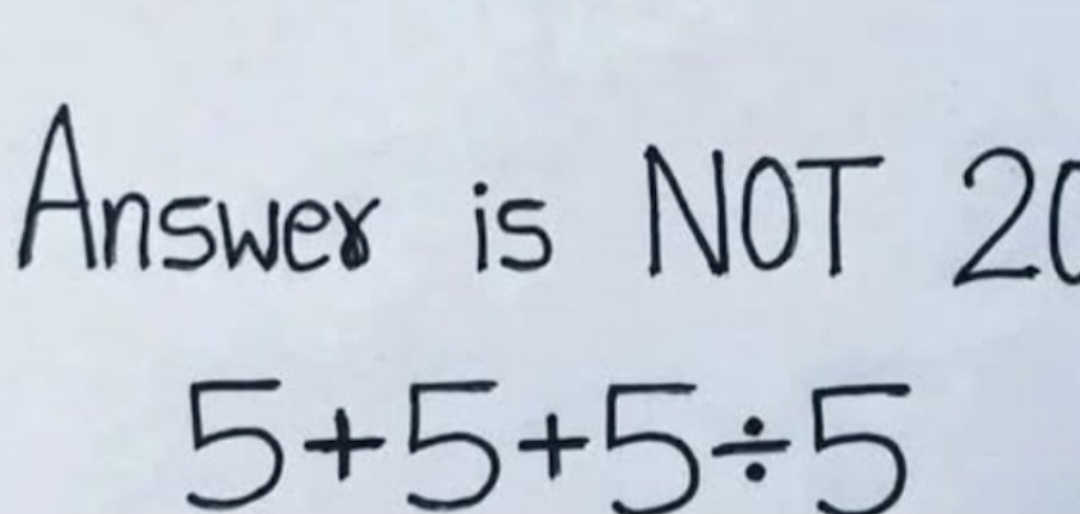
Look at the expression:
5 + 5 + 5 ÷ 5
First, solve:
5 ÷ 5 = 1
Now the expression becomes:
5 + 5 + 1
And that’s easy:
5 + 5 + 1 = 11
🎉 The correct answer is 11!
Why Isn’t the Answer 20?
This is where the puzzle catches people.
Someone might see four 5s and think:
5 + 5 + 5 + 5 = 20
But the fourth 5 isn’t being added.
It’s part of the division:
5 ÷ 5
That division must be completed before the additions.
So:
5 + 5 + 5 ÷ 5
becomes:
5 + 5 + 1
which equals:
11
The Easy Rule to Remember
A common way to remember the order of operations is PEMDAS:
P – Parentheses
E – Exponents
M – Multiplication
D – Division
A – Addition
S – Subtraction
Multiplication and division are handled before addition and subtraction.
One important detail: multiplication and division have the same priority, as do addition and subtraction. When operations have the same priority, you generally work from left to right.
Final Answer
So, can you solve the puzzle without falling for the trick?
Absolutely!
The expression is:
5 + 5 + 5 ÷ 5
First:
5 ÷ 5 = 1
Then:
5 + 5 + 1 = 11
✅ The answer is 11 — not 20!
Did You Get It Right?
Be honest… did you get 11 on your first try? 😄
If you got it right, congratulations—you spotted the order-of-operations trick!
If you answered 20, don’t feel bad. That’s exactly what makes these little puzzles so fun.
Share this puzzle with a friend or family member and see if they fall for the trick! And don’t forget to save it for your next brain-teasing challenge.Categories