
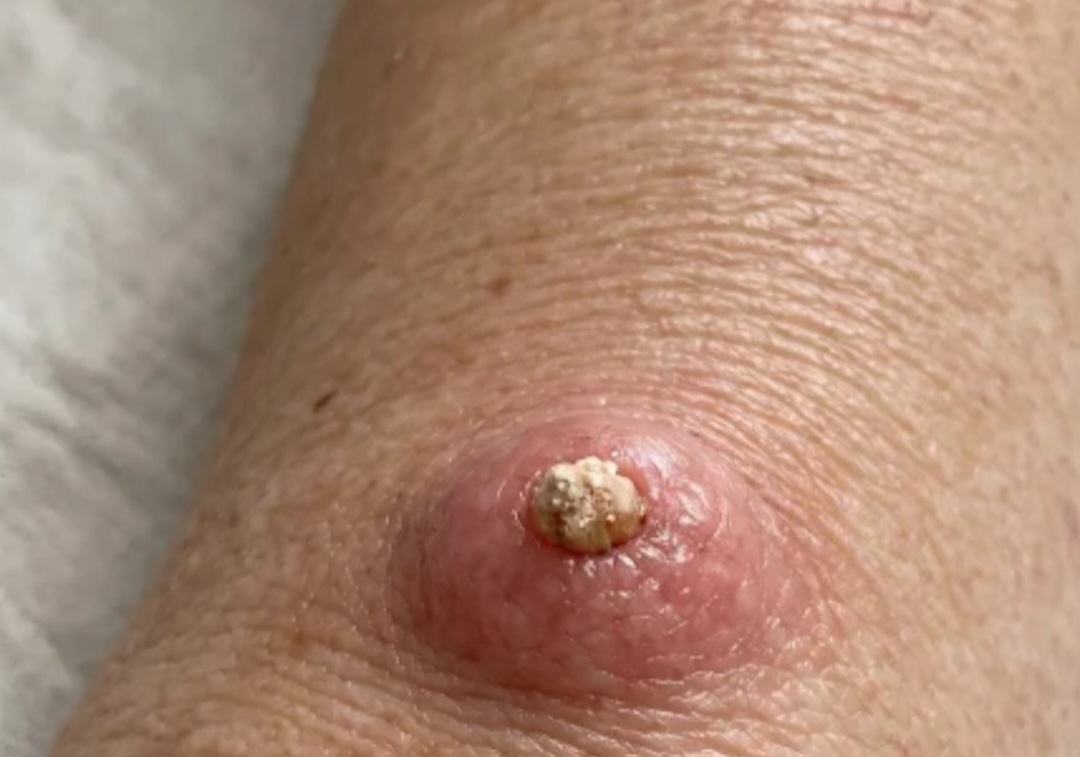
If you suddenly notice a fast-growing, pink, dome-shaped bump with a firm-looking plug in the middle, I completely understand why that would send you into a weekend spiral.A bump like this on the forearm can look dramatic, especially when it seems to appear quickly over a matter of weeks.One possibility doctors may consider is something called a keratoacanthoma.The tricky part is that keratoacanthoma can resemble other skin growths, including squamous cell carcinoma, so this isn’t really a “watch it forever and hope for the best” situation.The important thing is not to panic—but also not to ignore it.In this article, I’ll walk through what keratoacanthoma usually looks like, why clinicians take it seriously, what you can safely do while the clinic is closed, what you should avoid, and which warning signs mean you shouldn’t wait for a routine appointment.If you enjoy practical health and everyday information explained in plain English, consider subscribing by email so you don’t miss the next article.What Does a Keratoacanthoma Usually Look Like?Keratoacanthoma is a rapidly growing skin tumor that commonly develops on areas of skin exposed to the sun.It can begin as a small, firm bump and enlarge relatively quickly.A classic keratoacanthoma may eventually look like a round or dome-shaped pink, red, or skin-colored growth with a central depression filled with keratin, which can look like a hard plug or crust.That distinctive appearance is one reason the lesion can seem so unusual.But—and this is important—the appearance alone isn’t enough to tell you exactly what it is.Several skin conditions can resemble one another.That’s why a clinician may recommend examining the lesion closely and, when appropriate, obtaining a biopsy.Why Does It Have a Hard Plug in the Center?That central plug is usually made up of keratin, a tough protein found in the outer layer of the skin.When keratin builds up within the center of a lesion, it can create a firm, crusty, or plug-like appearance.This is one of the features that can make a keratoacanthoma look almost like a tiny crater.And yes, it can be alarming to see.But don’t try to remove the plug yourself.Trying to squeeze, scrape, cut, or pick at the center can cause bleeding, infection, inflammation, and additional injury to the skin.Why Do Doctors Take Keratoacanthoma Seriously?Here’s where the terminology can become confusing.Keratoacanthomas have traditionally been described as lesions that may grow rapidly and can sometimes regress on their own.
However, they can be extremely difficult to distinguish clinically from cutaneous squamous cell carcinoma, a type of skin cancer.
Because of that overlap, a suspicious lesion is generally evaluated rather than simply assumed to be a harmless keratoacanthoma.
The American Academy of Dermatology notes that squamous cell carcinoma can appear as a firm bump or growth and may develop on sun-exposed areas of skin. Diagnosis may require a skin biopsy.
So if a doctor mentions the possibility of keratoacanthoma, that does not mean your mom definitely has skin cancer.
It means the lesion deserves proper evaluation.
How Fast Can a Keratoacanthoma Grow?
One of the features that makes keratoacanthoma distinctive is its relatively rapid growth.
A lesion can enlarge noticeably over a period of weeks.
That is quite different from many ordinary moles and other benign skin marks that remain relatively stable for long periods.
But rapid growth isn’t specific to keratoacanthoma.
Other skin conditions can also change quickly.
That’s another reason not to rely on growth rate alone to make a diagnosis.
Where Do Keratoacanthomas Usually Appear?
They commonly occur on areas that receive significant sun exposure.
Possible locations include:
- Forearms
- Hands
- Face
- Ears
- Neck
- Lower legs
- Other chronically sun-exposed areas
Age and cumulative sun exposure are among the factors associated with keratoacanthoma and squamous cell carcinoma.
What Should Mom Do While the Clinic Is Closed?
If the lesion is otherwise stable and she feels well, the weekend can be used to protect the area and arrange appropriate medical care.
Don’t Pick at It
This is probably the most important rule.
Even if that central plug looks like something that should come out, leave it alone.
No squeezing.
No digging.
No cutting.
No home extraction.
Keep It Clean
If the surface becomes irritated or breaks open, gently clean it with soap and water.
Avoid harsh chemicals or homemade treatments.
Protect It From the Sun
Keep the area covered with clothing when practical.
Sun protection is important for skin health generally, especially when you’re dealing with an unexplained lesion on a sun-exposed area.
Take a Photograph
A simple photograph can actually be useful.
Take a clear picture in good lighting and, if possible, include a ruler beside the lesion to document its approximate size.
Don’t press the ruler against an open or painful area.
If the lesion changes before the appointment, having an earlier photograph can help the clinician understand how quickly it has evolved.
Should You Go to the Emergency Room?
A suspicious skin growth usually doesn’t require an emergency-room visit simply because it looks unusual.
A prompt appointment with a primary-care clinician or dermatologist is generally more appropriate.
However, seek urgent medical attention if the lesion develops significant bleeding that won’t stop with firm pressure, rapidly increasing swelling, severe pain, spreading redness, pus, fever, or other signs of a potentially serious infection.
And if she develops symptoms that are unrelated but clearly urgent—such as difficulty breathing, fainting, severe weakness, or another emergency—seek emergency care for those symptoms.
What Should You Avoid Putting on the Bump?
This is one of those situations where “natural” doesn’t necessarily mean better.
Avoid experimenting with:
- Vinegar
- Bleach
- Strong acids
- Essential oils
- Wart removers
- Household disinfectants
- Caustic skin products
- DIY freezing treatments
These products can burn or damage surrounding skin and make the lesion harder for a clinician to evaluate.
Don’t try to burn it off or freeze it at home.
And definitely don’t cut it off.
What Will the Doctor Do?
The first step is usually a careful examination.
A clinician may use a handheld magnifying device called a dermatoscope to examine the lesion more closely.
If the growth is suspicious, a skin biopsy may be recommended.
A biopsy means removing a sample of the lesion so it can be examined under a microscope.
That is often the only way to determine exactly what type of growth you’re dealing with.
Does a Biopsy Mean It’s Cancer?
No.
A biopsy is a diagnostic tool.
Doctors use biopsies for many different types of suspicious or unusual skin lesions.
If your mom’s doctor recommends one, it means they want more information—not that the diagnosis has already been made.
That’s an important distinction.
What Can Look Similar to a Keratoacanthoma?
A number of skin lesions can overlap in appearance.
Depending on the person and the lesion, possibilities may include:
- Squamous cell carcinoma
- Other types of skin cancer
- Inflamed cysts
- Warts
- Benign keratin-filled growths
- Other inflammatory or skin conditions
This is precisely why a photograph on the internet—or even a visual examination without appropriate testing—cannot reliably establish the diagnosis.
What Are the Warning Signs of Squamous Cell Carcinoma?
Squamous cell carcinoma can have different appearances.
According to the American Academy of Dermatology, warning signs can include a rough or scaly patch, a firm bump, a sore that doesn’t heal, or a growth that changes, bleeds, or becomes tender.
A lesion doesn’t need to look dramatic to deserve evaluation.
Sometimes the most important clue is simply:
“This wasn’t there before, and now it’s changing.”
What Makes This Different From an Ordinary Pimple?
A pimple can certainly become red, swollen, and tender.
But a persistent, firm, rapidly enlarging dome-shaped lesion with a central keratin-like plug is not something I’d recommend treating as an ordinary pimple without having it assessed.
Especially if it continues growing.
Don’t squeeze it simply because it resembles something that might have a “head.”
Could It Go Away on Its Own?
Some keratoacanthomas can regress, but that doesn’t make it safe to simply wait indefinitely.
The difficulty is that a lesion that looks like a keratoacanthoma can overlap with squamous cell carcinoma.
Because of that, waiting for spontaneous disappearance isn’t something to rely on as a home-management strategy.
Let a healthcare professional decide what evaluation is appropriate.
Is Keratoacanthoma Contagious?
No.
Keratoacanthoma itself isn’t something you catch from another person through ordinary contact.
It’s a type of skin tumor rather than an infectious disease.
Is Keratoacanthoma Caused by an Insect Bite?
Not usually.
Because these lesions can appear as a rapidly growing bump, people sometimes wonder whether they began with a bite.
The appearance of a lesion alone isn’t enough to determine its cause.
If a bump continues enlarging and develops the characteristic dome-and-plug appearance, it deserves medical evaluation rather than being assumed to be an insect bite.
Frequently Asked Questions
Is a fast-growing pink bump always a keratoacanthoma?
No.
There are many possible causes of a rapidly growing skin lesion.
Keratoacanthoma is one possibility, but a clinician needs to evaluate the lesion.
Is a keratoacanthoma cancer?
The terminology is complicated because keratoacanthoma and squamous cell carcinoma can look extremely similar.
Some clinicians classify keratoacanthoma as a distinct lesion, while others consider it a variant or well-differentiated form within the squamous-cell-carcinoma spectrum.
Either way, a suspicious lesion should be professionally assessed.
Should I pop a keratoacanthoma?
No.
Do not squeeze, pop, cut, scrape, or dig into a suspected keratoacanthoma.
Can I put a bandage over it?
If the surface is irritated or has been rubbed by clothing, a clean dressing can help protect it.
Avoid applying irritating products underneath the dressing.
Should I take a picture of it?
Yes.
A clear photograph can document its appearance and approximate size while you’re waiting for an appointment.
How quickly should Mom see a doctor?
Because the lesion is described as new and rapidly growing, arrange a medical evaluation promptly rather than waiting weeks or months.
If the regular clinic is closed, you can contact an appropriate urgent-care service or the clinic’s after-hours line for guidance about timing.
Does every suspicious skin bump need a biopsy?
Not necessarily.
The clinician will decide based on the appearance, history, location, and other factors.
If the diagnosis can’t be made confidently from examination, a biopsy may be recommended.
Keep reading — tap the button below to continue.